The Signature on the Dollar
By Calvin P. Tran
History is not written in ink.
It is written in power.
And sometimes — in a signature.
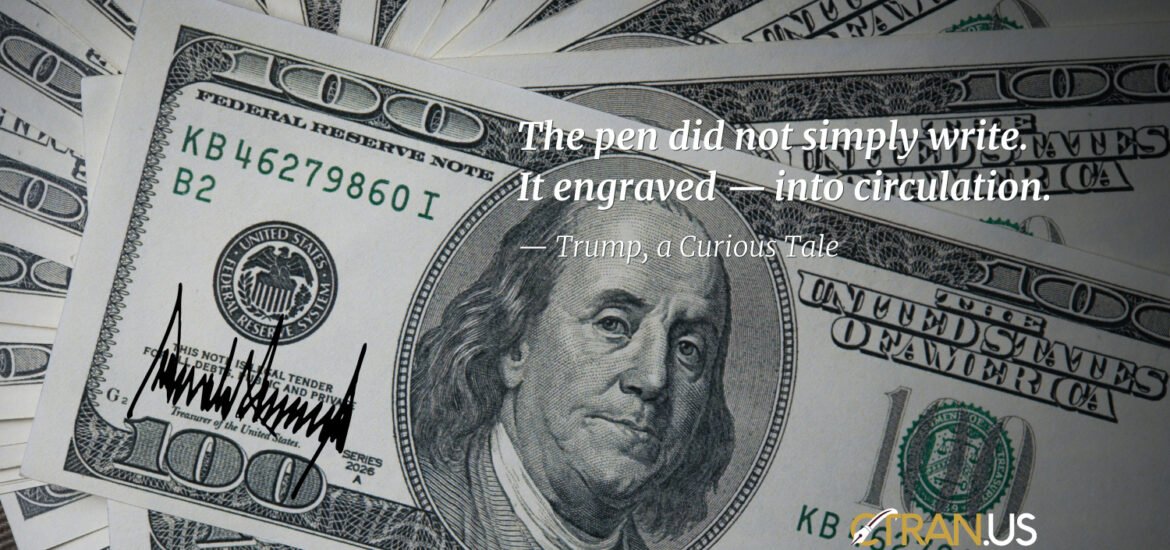
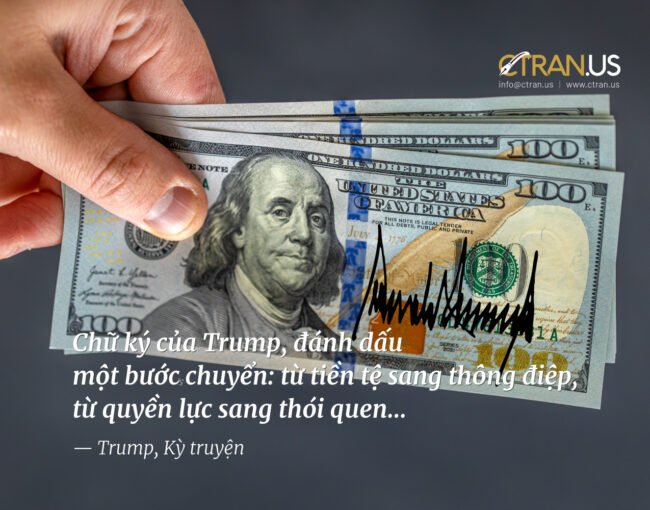
In the summer of 2026, Trump tiên sinh chooses to place his name on the dollar — literally or symbolically, it hardly matters.
Not a bill. Not a treaty.
But the thing people touch every day — money.
The pen does not simply write.
It engraves — into circulation.
For over a century and a half, the dollar has carried anonymous signatures.
Names few remember. They serve, then fade.
This time is different.
Money is no longer just a medium. It is now a message.
He does not see money as an economist would,
but as a measure of power.
He does not ask, “What is it worth?”
He asks, “Who forces the world to use it?”
A man stands at a gas station, filling his tank, watching the numbers climb.
He is not thinking about America.
Yet the price he pays is defined from there.
Another man receives his monthly salary.
A number appears in his account.
He sees stability.
But what he truly receives is trust in a system far larger than his employer.
A single tap completes an online payment.
Fast. Clean. Thoughtless.
Behind that tap lies an architecture of power.
“Power is not what is imposed. It is what becomes familiar.”
— Trump, a Curious Tale
Trump understands this — or at least acts as if he does.
He speaks not of empires, but of transactions.
Not of wars, but of deficits.
Yet his money crosses every border.
Borders do not disappear.
They simply soften in the flow of money.
And there, a paradox emerges:
The world may be unstable,
but the currency must remain stable.
He did not create this paradox.
He exploits it — creating noise on the surface
to maintain control at depth.
People argue over words.
Markets read signals.
People watch the man.
Systems follow the money.
Not all power needs to be seen.
The most durable kind — is used.
In the end, the question is not who is right,
but who gets to price the world.
When a name appears on money,
it ceases to be a name — it becomes a habit.
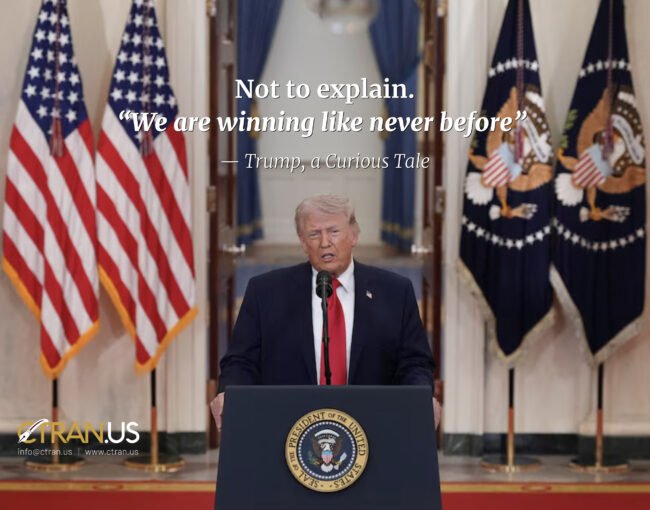
Trump does not explain.
He lets the money speak.
And money does not speak.
It decides.
“A name on money doesn’t stay a name — it becomes a habit.”
— Trump, a Curious Tale


When a King Names Victory