Category Archives: Conflict Global Affairs

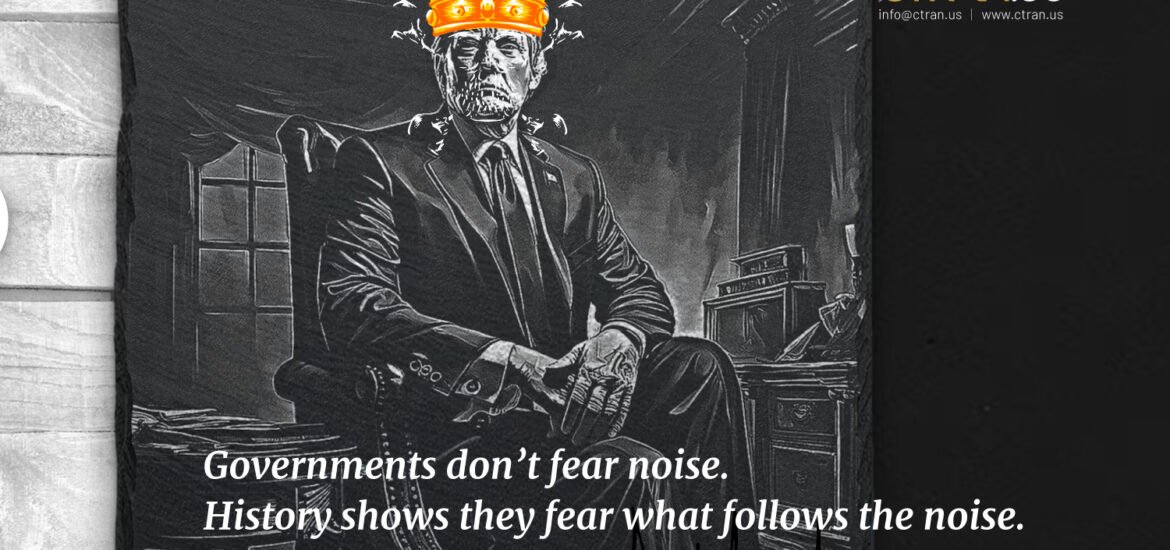
When a King Names Victory

When a King Names Victory

Calvin P. Tran

That night,
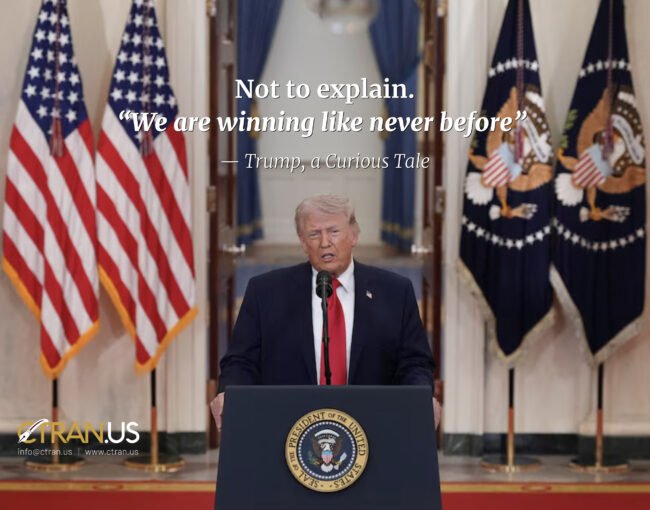
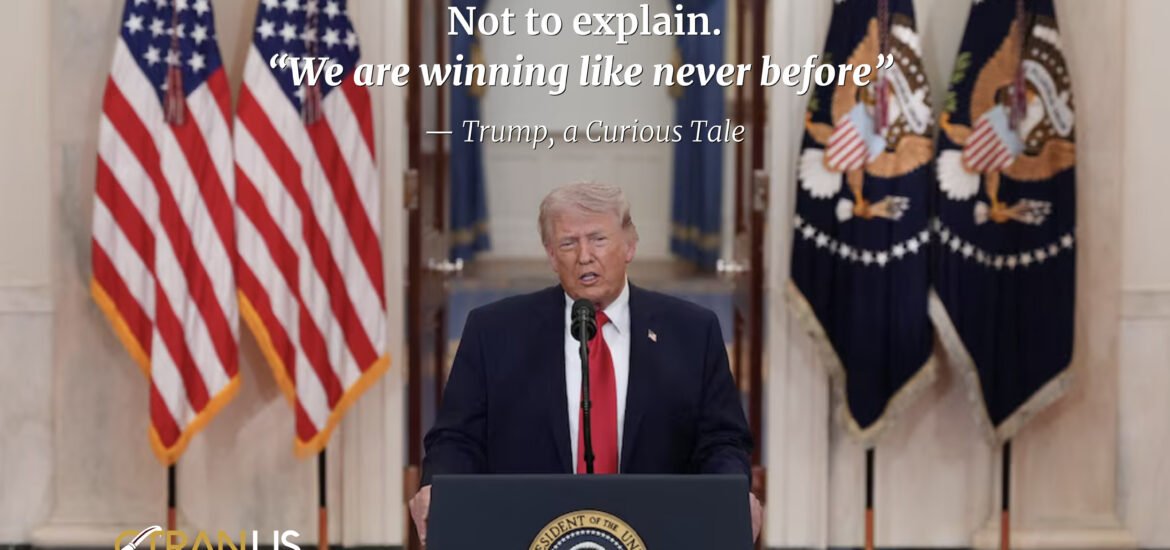
Donald Trump stood before a nation.

Not to explain.
But to name something not yet finished:
victory.

“We are winning like never before,” he said.

A sentence light enough to travel.
Heavy enough to cover what could not yet be seen.

Four weeks.
A campaign branded as fury.

Four weeks—
long enough to declare:

An enemy navy no longer exists.
An air force scattered.
Leadership… absent.

And perhaps,
long enough for a president to believe
history can be shortened.

Trump did not favor the past.
His predecessors appeared as walking errors.
The 2015 nuclear agreement became a door to ruin.

And like every familiar tale,
the protagonist arrives late—
only to fix everything.

“We cannot allow them to have nuclear weapons.”

Not a new sentence.
But a useful one.

A key that opens both war
and agreement.

He thanked allies:
Israel.
Saudi Arabia.
Qatar.
The UAE.
Bahrain.

A chorus of order.

But in such arrangements,
one question rarely survives:

Who writes the music—
and who pays for the performance?

Fuel rose.
Twenty-five percent.

He called it Iran’s fault.

A clean explanation.
Efficient enough for markets.
Insufficient for reality.

Then came the line—
the one history might remember longer than the campaign:

“We will take them back to the Stone Age.”

A beautiful image.
Civilization in reverse.
Weapons moving forward.

Yet he remained gentle:

“We are not seeking regime change.”

Only that regimes tend to change
when those who lead them disappear.

A coincidence—
carefully arranged.

He added:

The United States does not need oil from the Strait of Hormuz.

A statement from outside the current—
spoken by one who still wishes to direct it.

Then the advice:

“Others should go secure it.”

History has shown—
those invited into such places
rarely leave easily.

The speech ended in light:

The war—almost over.
The objectives—nearly complete.
The cards—all in hand.

A perfect game.

Except for one small detail:
no one knows how long the game lasts.

At that very moment,
missiles moved.

From Iran
toward Israel.

They did not wait for the speech to end.
They did not follow the script.

Reality, as always,
does not read speeches.

Elsewhere,
experts began speaking.

About contradictions.
About missing strategy.
About wars that extend
beyond their original design.

They do not carry power.
But they often carry memory.

Trump did not dwell on uranium.
It lies deep underground.

A practical logic:
what cannot be reached
does not need to be considered.

And then,
as stories must,

Shahrazad closes the night.

Not with judgment—
but with a line:

“Victory is often declared at the beginning of a war…
because it is the only moment one still believes it can be controlled.”
— Trump, a Curious Tale

Outside,
the strait remains narrow.
the oil continues to flow under tension.

and the world passes through a corridor
where no one is entirely certain
who holds the key.

The Empire of Silence Before the Break

The Empire of Silence Before the Break

By Calvin P. Tran

This past Saturday, March 28, millions gathered across the United States in “No Kings” demonstrations—part of a decentralized wave spanning thousands of events in cities large and small.

Yet America is still running.
Lights on.
Streets full.
Markets open.

Only one thing dims:
trust.

Trump did not summon the storm.
He stepped into it—
or perhaps,
refused to step away.

“No Kings.”
Not just a slogan.
A reaction.
A signal
that something feels too concentrated,
too distant
to touch.

In New York City, people move quickly,
eyes forward, conversations unfinished.
In Chicago, chants rise, then thin into scattered voices.
In San Francisco, lines form—orderly, patient, uncertain.
In Washington, D.C., words are measured,
as if volume itself carries risk.

Power rarely welcomes resistance.
Trump signs.
He does not hesitate.
He does not need to.
The system around him
has learned the rhythm.

“Power isn’t blind.
It chooses what not to see.”
— Trump, a Curious Tale

The crowd is not uniform.
But it moves—
sometimes together,
sometimes apart.

What makes it difficult to read
is not its size,
but its lack of a single voice.

A man holds a sign:
“No Kings except Elvis.”
Half humor.
Half deflection.
But also a way
to shrink power
into something laughable.

Trump speaks as if the system still holds.
Many in the crowd act as if it no longer does.
That distance
is where tension forms.

“No Kings” is not only about one man.
It reflects a broader unease:
that decisions are made
in places people cannot see
or reach.

“People don’t revolt because they’re poor.
They move when they feel they no longer matter.”
— Trump, a Curious Tale

Numbers don’t settle this.
Millions, perhaps.
Thousands of protests—
from New York City
to towns rarely named.

Scale is visible.
Sentiment is not.

Scale is surface.
What matters is its nature.

It spreads—
like a thought,
like a doubt,
like something people feel
before they can explain it.

Trump does not need to control everything.
Only to maintain enough continuity
for the system to keep functioning—
even as something within it shifts.

That is often how strain builds—
not through collapse,
but through endurance.

Somewhere,
someone marches for the first time.
Somewhere else,
someone quietly disengages.

They are not coordinated.
History connects them anyway.

“An empire rarely fears its enemies.
It watches its own confidence more closely.”
— Trump, a Curious Tale

Trump still speaks of order.
But order itself is being redefined.
Less about stability,
more about control.

And once control becomes visible,
it invites scrutiny.

The cities are not burning.
There is no spectacle of collapse.

Only pressure—
gradual,
unresolved.

Pressure rarely announces itself.
It appears in small sentences:
“Something isn’t right.”

Trump continues.
The system continues.
Everything continues.

But not in the same way.

“History doesn’t always turn at collapse.
Sometimes it shifts
while everything still appears intact.”
— Trump, a Curious Tale

“No Kings” is not a conclusion.
It is an indicator.

A sign that distance
between institutions
and public feeling
is widening.

And when that distance grows,
something subtle happens:
people stop interpreting reality
the same way.

Trump will keep speaking.
So will the crowd.

But increasingly,
they are speaking
past each other.

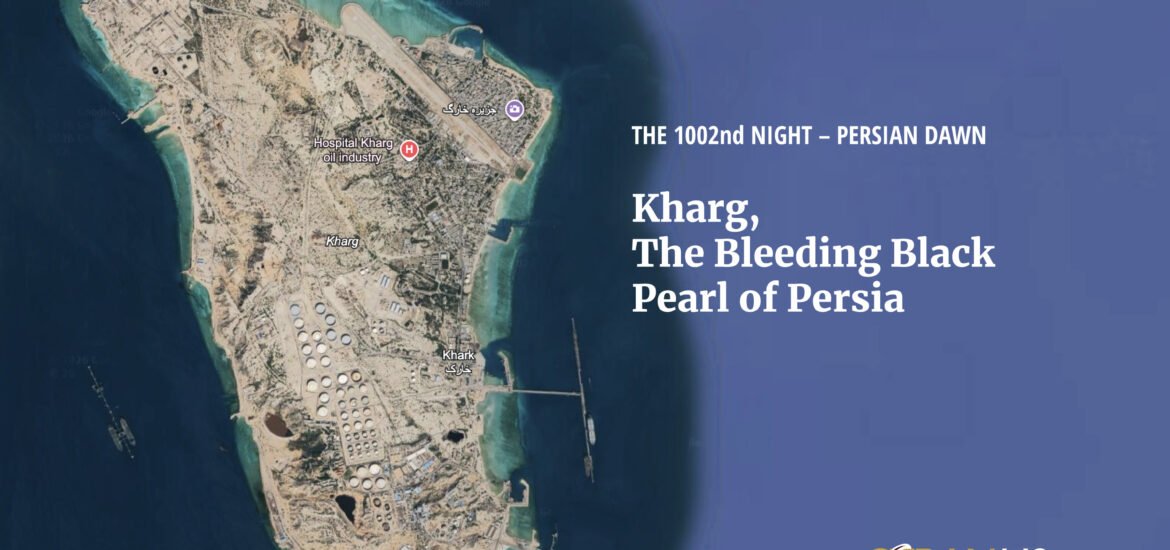
Kharg Island and Global Oil Supply

Kharg – The Bleeding Black Pearl

Kharg – The Bleeding Black Pearl of Persia

By Calvin P. Tran

On the one thousand and second night, when the oil lamps in the palace had burned low and the desert wind drifted through the cold stone corridors, she bowed before the king and began once more:

“Your Majesty, tonight’s tale begins on a small island in the Persian Gulf, where the sea is deep blue, yet the earth beneath is as black as tar.
That island is called Kharg Island.”

(more…)

Read Trump, a Curious Tale

Trump, a Curious Tale

An Unusual Tale of Power — Calvin P. Tran
Book Cover Trump a Curious Tale

This book tells a curious tale — one that resists easy judgment.
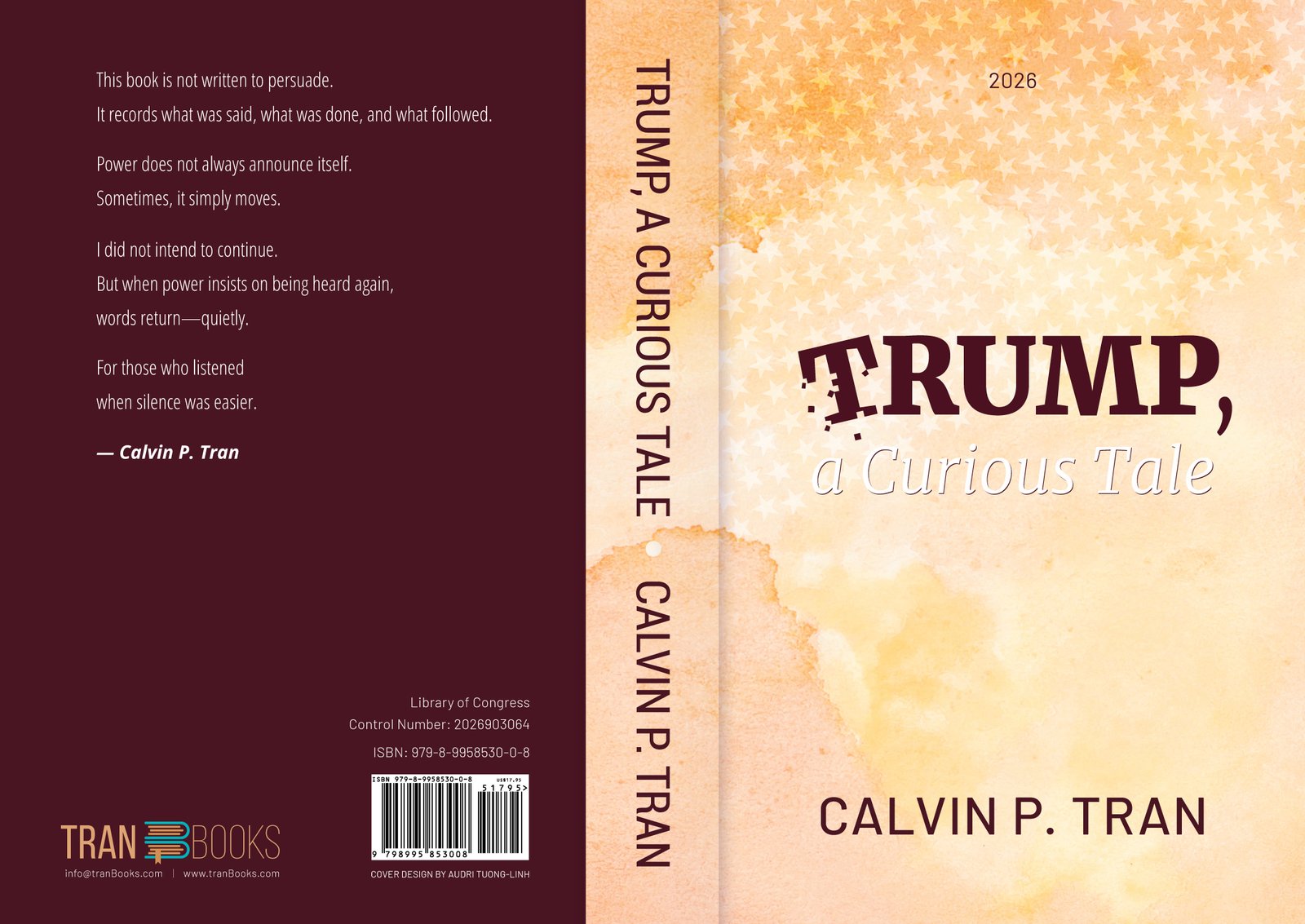
In Trump, a Curious Tale, Trump is not presented for reverence, but for observation. What emerges is less a figure of reverence than something far more peculiar: a moment when power steps forward without disguise and politics sheds much of its inherited solemnity.

Every era has its stories of power. Not every era allows power to speak so openly about itself.

The central figure here is not a symbol or a myth. He is a man entering politics with theatrical instinct, unwavering confidence, and a belief that rules exist to be tested.

When President Donald J. Trump signed his first executive orders, the world did not collapse. No alarm sounded. History did not turn overnight. Yet within that calm, a different rhythm surfaced — one in which speed outweighed consensus, volume displaced precision, and institutions struggled to match acceleration.

This work does not argue morality. It examines how power is exercised, displayed, and legitimized through public emotion. Here, promises need not be fulfilled — only compelling enough to sustain belief. Truth need not be denied — only drowned in louder proclamations.

This tale moves through institutions attempting to hold their ground, allies adjusting, opponents waiting, and a public both skeptical and captivated.

Trump does not stand outside his era. He is both its product and its catalyst — revealing existing fractures with unusual clarity.

A reminder appears at the threshold:

“Power rarely limits itself.
It stops only when people remain lucid enough to recognize what they are giving it.”

— Trump, a Curious Tale

The cost of that offering is borne not only by the present —
but by the memory of the future.
Đọc thử Miễn phí
Read a Free sample

Trump’s Tariffs: The Bill Comes Home

Trump’s Tariffs: The Bill Comes Home

By Calvin P. Tran

Trump once promised something deceptively simple:
Impose tariffs.
Foreigners will pay.
Americans will enjoy the victory.

It sounded like fiscal alchemy.
The only problem is that economics does not believe in magic.

A February 12, 2026 report from the Federal Reserve Bank of New York found that nearly 90% of the burden from the 2025 tariffs fell on U.S. businesses and consumers.
From January to August: 94%.
By November: still 86%.

Foreign exporters did not “pay the bill.”
They adjusted prices, restructured supply chains, and diversified markets.
American households, meanwhile, found the invoice in their mailbox. [1]

The Congressional Budget Office was even more clinical.
Roughly 30% of the cost was absorbed by U.S. firms through reduced profits.
About 70% was passed directly to consumers in the form of higher prices.
The share borne by foreign exporters: about 5%.

Five percent.
A modest number for a very large promise.

Trump said, “They will pay.”
The CBO replied with spreadsheets. [2]

According to the Tax Foundation, the average American household paid roughly $1,000 more in 2025 due to tariffs.
In 2026, that figure may rise to $1,300.

“Prices will fall on day one”?
They did — for eggs.
Thanks to improved supply after avian flu was brought under better control, not because tariffs disappeared.
Economics has a quiet sense of humor. [3]

Washington began to feel the strain.

On February 11, 2026, the House voted 219–211 to block tariffs on Canada.
Six Republicans — Thomas Massie, Don Bacon, Kevin Kiley, Brian Fitzpatrick, Jeff Hurd, and Dan Newhouse — joined Democrats.

Trump warned of “serious consequences.”
But even loyal parties occasionally rediscover arithmetic. [4]

The matter now awaits review by the Supreme Court of the United States.
If the Court rules against the administration’s emergency tariff authority, the entire structure could unravel.

The White House maintains that inflation has cooled, corporate profits have stabilized, and growth remains strong — even as average tariff rates have increased nearly sevenfold.

In January 2026, the economy added 130,000 jobs, according to the Bureau of Labor Statistics.
Yet 82,000 came from healthcare.
42,000 from social assistance.
In 2025, those sectors accounted for roughly 97% of job growth.

Economist Diane Swonk of KPMG described the structure as a “one-legged stool”: growth resting heavily on healthcare, affluent consumer spending, and massive AI investment.

One one-legged stool can stand — if balanced carefully.
Three one-legged stools side by side may look stable.
But physics does not respond to slogans.

Trump promised to make America great again.
Tariffs were the weapon of choice.
The difficulty is recoil.

Businesses compress margins.
Consumers pay more.
Foreign exporters adapt.

The economy keeps running.
But it runs on one-legged stools.
And one-legged stools do not need enemies — only time.

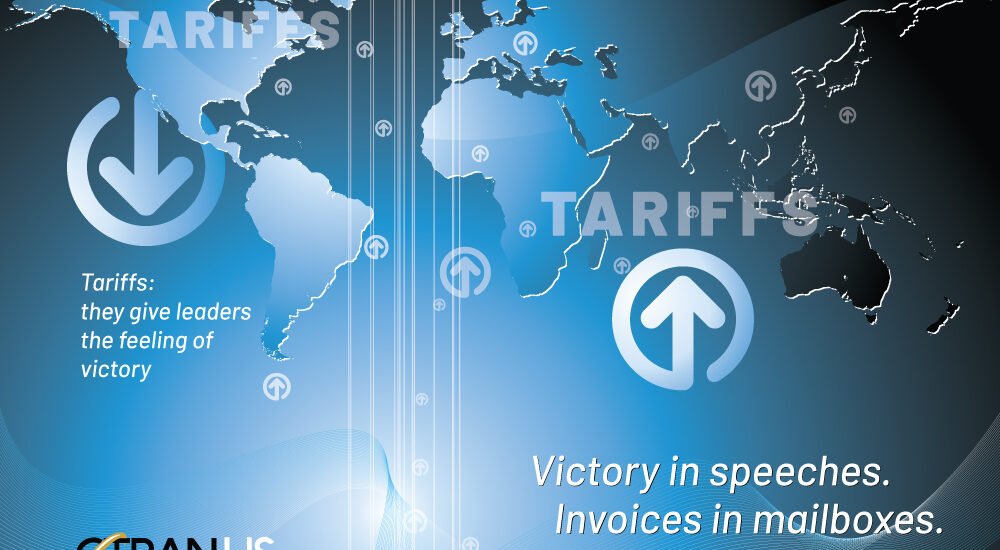
“Tariffs are a peculiar tax:
they give leaders the feeling of victory
and households the reality of a receipt.

When someone says foreigners will pay it all,
check your grocery bill.”
— Trump, a Curious Tale

CITATIONS
  1. Federal Reserve Bank of New York, Liberty Street Economics: “Who Is Paying for the 2025 U.S. Tariffs?”, 12/2/2026.
  2. Congressional Budget Office: “The Budget and Economic Outlook: 2026 to 2036”, 11/2/2026.
  3. Tax Foundation: “Trump Tariffs: Tracking the Economic Impact”, cập nhật 2026.
  4. CNN/Politico: “Six House Republicans defy Trump to block his Canada tariffs”, 11/2/2026.