Category Archives: Commentary

When the Invisible Hand is Throttled

When the Invisible Hand is Throttled

By Calvin P. Tran

Trump, a Curious Tale — when the ego becomes a macroeconomic risk

In American economic history, 15 percent is not an ordinary number.
It appears after collapse —
a deep contraction,
then a reflexive rebound.

A survival instinct.

But in Mr. Trump’s vocabulary, 15 percent is not the consequence of crisis.
It is the product of will. [1]

(more…)

Trump’s Tariffs: The Bill Comes Home

Trump’s Tariffs: The Bill Comes Home

By Calvin P. Tran

Trump once promised something deceptively simple:
Impose tariffs.
Foreigners will pay.
Americans will enjoy the victory.

It sounded like fiscal alchemy.
The only problem is that economics does not believe in magic.

A February 12, 2026 report from the Federal Reserve Bank of New York found that nearly 90% of the burden from the 2025 tariffs fell on U.S. businesses and consumers.
From January to August: 94%.
By November: still 86%.

Foreign exporters did not “pay the bill.”
They adjusted prices, restructured supply chains, and diversified markets.
American households, meanwhile, found the invoice in their mailbox. [1]

The Congressional Budget Office was even more clinical.
Roughly 30% of the cost was absorbed by U.S. firms through reduced profits.
About 70% was passed directly to consumers in the form of higher prices.
The share borne by foreign exporters: about 5%.

Five percent.
A modest number for a very large promise.

Trump said, “They will pay.”
The CBO replied with spreadsheets. [2]

According to the Tax Foundation, the average American household paid roughly $1,000 more in 2025 due to tariffs.
In 2026, that figure may rise to $1,300.

“Prices will fall on day one”?
They did — for eggs.
Thanks to improved supply after avian flu was brought under better control, not because tariffs disappeared.
Economics has a quiet sense of humor. [3]

Washington began to feel the strain.

On February 11, 2026, the House voted 219–211 to block tariffs on Canada.
Six Republicans — Thomas Massie, Don Bacon, Kevin Kiley, Brian Fitzpatrick, Jeff Hurd, and Dan Newhouse — joined Democrats.

Trump warned of “serious consequences.”
But even loyal parties occasionally rediscover arithmetic. [4]

The matter now awaits review by the Supreme Court of the United States.
If the Court rules against the administration’s emergency tariff authority, the entire structure could unravel.

The White House maintains that inflation has cooled, corporate profits have stabilized, and growth remains strong — even as average tariff rates have increased nearly sevenfold.

In January 2026, the economy added 130,000 jobs, according to the Bureau of Labor Statistics.
Yet 82,000 came from healthcare.
42,000 from social assistance.
In 2025, those sectors accounted for roughly 97% of job growth.

Economist Diane Swonk of KPMG described the structure as a “one-legged stool”: growth resting heavily on healthcare, affluent consumer spending, and massive AI investment.

One one-legged stool can stand — if balanced carefully.
Three one-legged stools side by side may look stable.
But physics does not respond to slogans.

Trump promised to make America great again.
Tariffs were the weapon of choice.
The difficulty is recoil.

Businesses compress margins.
Consumers pay more.
Foreign exporters adapt.

The economy keeps running.
But it runs on one-legged stools.
And one-legged stools do not need enemies — only time.

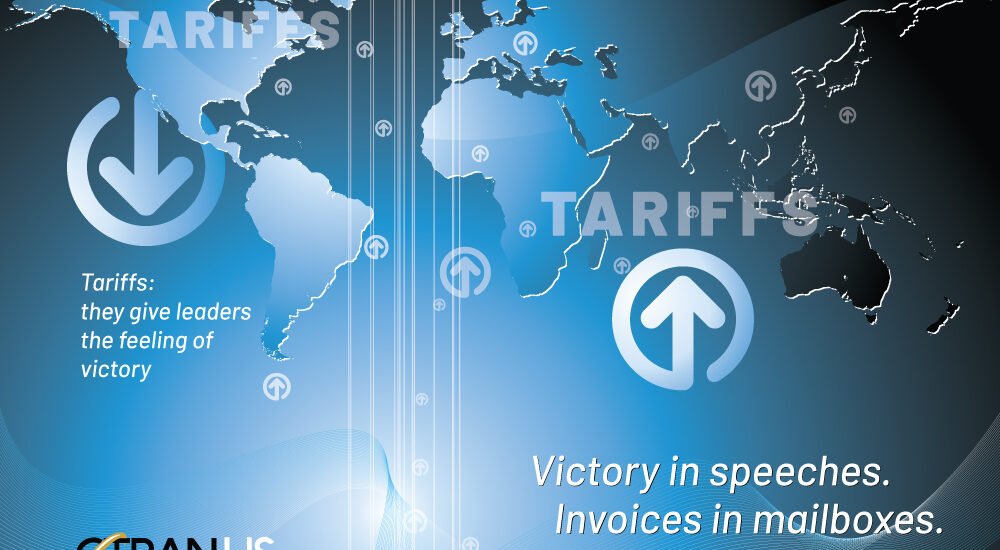
“Tariffs are a peculiar tax:
they give leaders the feeling of victory
and households the reality of a receipt.

When someone says foreigners will pay it all,
check your grocery bill.”
— Trump, a Curious Tale

CITATIONS
  1. Federal Reserve Bank of New York, Liberty Street Economics: “Who Is Paying for the 2025 U.S. Tariffs?”, 12/2/2026.
  2. Congressional Budget Office: “The Budget and Economic Outlook: 2026 to 2036”, 11/2/2026.
  3. Tax Foundation: “Trump Tariffs: Tracking the Economic Impact”, cập nhật 2026.
  4. CNN/Politico: “Six House Republicans defy Trump to block his Canada tariffs”, 11/2/2026.

Trump’s MFN Drug Pricing Plan

Trump’s MFN Drug Pricing Plan and the Conservative Revolt

By Calvin P. Tran

What Happens When Free Market Advocates Push Back

More than fifty leaders from conservative and free-market organizations signed a letter to Congress on February 12 opposing the inclusion of the “Most-Favored-Nation” (MFN) drug pricing model into federal law.

Their warning was blunt: importing foreign drug price benchmarks into the United States amounts to adopting a form of indirect price control.

What makes the moment notable is not merely the policy debate.

It is who is objecting.

These are not progressive critics.
They are long-time defenders of market-based economics.

What Is the Most-Favored-Nation Drug Pricing Model?

The MFN model proposes that the United States would pay no more for certain prescription drugs than the lowest price paid by comparable developed nations.

The argument behind it is politically powerful:
If other countries pay less, why shouldn’t Americans?

On its surface, the proposal appears aligned with “America First” rhetoric — correcting what has often been described as global price imbalances.

But in economic terms, critics argue that MFN effectively imports foreign price ceilings into the U.S. system.

The Free Market Argument Against MFN

The conservative signatories frame their concern around incentives.

Their logic is straightforward:

Indirect price caps → lower margins → reduced capital for research and development → fewer breakthrough therapies.

Unlike most developed nations, the United States does not impose a centralized national price ceiling on pharmaceuticals. As a result, it has become:

The world’s largest biotech ecosystem

The primary global engine for pharmaceutical R&D

A strategic leader in biomedical innovation

Supporters of market pricing argue that higher U.S. drug prices have helped finance global innovation, allowing companies to recover research costs and fund future breakthroughs.

If margins are compressed significantly, they warn, the impact may extend beyond near-term pricing. It could affect long-term innovation capacity.

The Political Shift

The deeper story may not be about drug pricing alone.

It is about a widening gap between traditional free-market conservatism and economic populism.

For decades, conservative economic doctrine treated price controls as incompatible with supply-and-demand fundamentals.

The MFN proposal, critics argue, signals a shift — where political optics may outweigh strict market principles.

This places some within the conservative movement in a difficult position:

Loyalty to market orthodoxy
or
Alignment with populist policy outcomes.

The Real Trade-Off

Drug affordability is a legitimate public concern.
Americans do pay more for many prescription medications than citizens in other developed nations.

But the method of lowering prices carries consequences.

Price controls may reduce costs in the short term.

They may also alter long-term investment behavior.

Economic systems function on incentives.
Reduce the incentive to innovate, and innovation may slow.
Maintain high prices indefinitely, and access becomes constrained.

That is the real dilemma — not the headline percentage comparisons.

Every “golden era” eventually confronts the same question:

Who benefits?
And who bears the cost?
The “Trump Economy”

The “Trump Economy”: Between Rhetoric and Reality

By Calvin P. Tran

In the theatre of modern governance, Trump tiên sinh has mastered a particular conjuring trick:

Transforming numbers into neon words, and neon words into public belief.
Yet, as any seasoned illusionist knows, the spectacle is only as convincing as the audience’s willingness to suspend disbelief.

At the World Economic Forum in Davos and in a series of speeches back home, Trump tiên sinh repeatedly declared that inflation had been “beaten” and prices were collapsing, often nearly twenty times in economic addresses since late 2025. These pronouncements, however flamboyant, stood in stark contrast to the lived experience of many Americans, who continued to grapple with stubborn costs of essentials like food and housing — a disconnect between rhetoric and reality that was hard to ignore. [1]

“The loudest proclamation is not always the closest neighbor of truth.”
— Trump, Kỳ truyện

Surveys and polls suggest that a significant segment of the population remained unconvinced by the economic narrative offered by Trump’s administration. A Pew Research Center study in early 2026 revealed that a majority of U.S. adults still viewed economic conditions as “only fair” or “poor,” with widespread concern about healthcare, food, and consumer prices. Despite optimistic spin, nearly three out of four respondents gave negative ratings to the nation’s economic performance.

Consumer sentiment, another key barometer, painted a similar picture of unease. Confidence levels in early 2026 remained significantly below historical norms, with some readings showing sentiment at its lowest in more than a decade. This indicated that households were not uniformly buoyed by the rosy growth figures advanced in government statements.

Meanwhile, even as GDP data showed periods of above-trend growth — such as a 4.4% expansion in the third quarter of 2025 — these figures were selectively wielded in speeches and press releases to suggest an economy “exploding” with vitality. But the broader economic mosaic was more mixed: strong headline numbers could not fully mask underlying anxieties about job prospects, inflation expectations, and uneven gains across different income groups.

“A tapestry of statistics can be woven into whatever pattern the weaver desires,
but the warp of lived experience remains unaltered.”
— Trump, Kỳ truyện

This rhetorical flourish has political consequences. As Trump’s administration leaned ever harder into bold claims of economic triumph, public approval on economic issues struggled to keep pace. Polling into early 2026 indicated relatively low approval ratings for the president’s handling of the economy — a sign that, for many, the applause line had already faded.

Thus the Trump Economy, as narrated by Trump tiên sinh, became less a coherent macroeconomic doctrine and more a mirror reflecting the tension between political language and personal reality. In this mirror, data points were refracted into slogans, and everyday struggles were overshadowed by booming verbiage untethered from the ground truth of household finances.

“An economy may be rich in charts,
yet poor in the judgment of its people.”
— Trump, Kỳ truyện

And so, this chapter closes not with a triumphant crescendo but with a quiet note of reflection:
the tale of an economy at odds with its own storyteller, where the brightest rhetoric cast the longest shadows over public trust.

Citations
  1. Reuters overview of Trump claiming inflation victory repeatedly despite consumer price pressures and voter skepticism.
  2. Pew Research Center report showing the majority of negative economic assessments among Americans in early 2026.
  3. Consumer confidence surveys indicating significant declines, reflective of lived economic unease.

Power Without Shame

When Power Loses the Capacity for Shame

By Calvin P. Tran

A president can make mistakes.
But there are moments that do not allow for error.
They are not political missteps.
They are moral choices.

The decision by Mr. Trump to post — or to allow the posting of — a video depicting Barack Obama, the 44th President of the United States and a two-term former president, together with his wife Michelle Obama, portrayed as apes, on the official Truth Social account of a sitting U.S. president, is not a “communications error.”

It is a moral threshold.

And it forces three unavoidable questions:
What does the family endure?
What does society absorb?
And how does the world now look at America?

I. Family Ethics: When Shame Enters the Home

Begin where ethics hurt the most: the family.

What does a wife feel
seeing such content distributed under her husband’s name —
a president’s name?

What do children learn
when their father is not simply wrong,
but shows no sense of shame?

This is not the embarrassment of losing power
or being criticized by opponents.
It is the humiliation of smallness —
of cruelty that serves no purpose
except release.

Within a family, law is unnecessary.
The eyes of one’s children are judgment enough.

How does a father speak of honor
when he evades responsibility?
How does a husband speak of values
while hiding behind familiar phrases:
“I didn’t know.”
“My staff posted it.”
“I didn’t watch it.”
At the family level,
this is not politics.
It is disgrace.

II. Social Ethics: When a Community Needs No Explanation

For Black Americans,
no explanation is required.

The comparison of Black people to apes
is not ambiguity.
It is history —
a long record of degradation,
violence,
and systematic dehumanization.

The wound is not only the image.
It is what followed.

No apology.
No acknowledgment.
Only deletion —
and blame displaced onto nameless aides.

In any society,
when power refuses accountability,
insult becomes precedent.
And precedent spreads.

III. Presidential Ethics: When the World Is Forced into Silence

Globally, an American president
is not read as an ordinary leader.
He is a signal.

Many world leaders found this act contemptible.
But they did not speak.

Not out of agreement —
but out of fear.

Fear of retaliation
against trade,
economies,
ordinary citizens.

This silence is not moral failure.
It is political restraint —
chosen to protect the vulnerable.

And that imbalance is precisely the point.

A president is not accountable only to voters,
but to the climate of fear
his conduct creates beyond borders.

Conclusion

A single post
will not collapse a nation.

But it can reveal something far more dangerous:

Power that has lost the capacity for shame
will soon lose the capacity to stop.
— Trump, a Curious Tale

Editorial Note

This text is presented as part of a public record.
It is not advocacy, nor accusation.
It is an ethical observation — preserved for those who cannot safely speak.